What does it take to have a good indoor climate?
It can be difficult to recognise which of the invisible indoor climate challenges you may have. But if you don't pay attention, you can risk dangerous conditions such as mould growth and high radon levels.
Some indoor climate problems can be solved with a simple change, while other challenges may require a major renovation.
Moisture and particles in the air
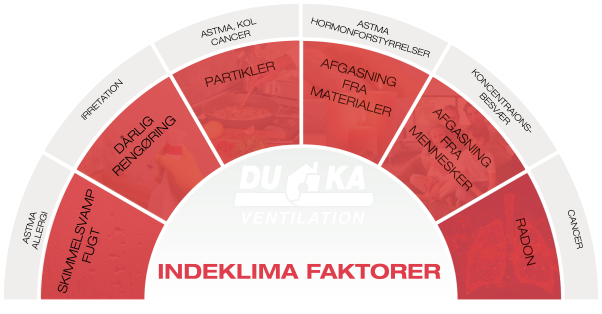
Moisture and mould It starts out invisible, but when moisture starts to form on the windowsill or mould stains on the wall, it has definitely become visible. Moisture and mould can be really bad if you have asthma or allergies. For many people, damp and mould appear after they have energy renovated their house and insulated it. The solution can be more extensive, but a great start is to invest in ventilation. You can get both domestic ventilation and heat recovery ventilation systems that prevent damp and mould.
The cleaning contributes to the indoor climate if it is difficult to clean corners or you have many surfaces, dust and odours can be a challenge.
Particles
Particles from the kitchen is one of the biggest culprits when it comes to indoor air quality. The consequences can also be significant, as particles from burning can lead to asthma, COPD and cancer. Therefore, the hood must of course be running and you must remember to provide the hood with replacement air in the form of an open window or wall valve. Switch on the cooker hood 5 minutes before you start cooking to create a small negative pressure, which makes the suction work better.
To get rid of particles in your home, a ventilation system can be the solution. DUKA One is a ventilation solution that ventilates the room 24 hours a day. For 70 seconds, the system sucks out stale and moist air, storing heat in the unit's ceramic core. After 70 seconds, the system's motor reverses and blows in fresh air that is heated by the ceramic core. This constantly changes the air, ventilating away particles and moisture and saving on heating bills as the heat in the home is recycled. DUKA One is mounted directly in the outer wall and can be installed wherever there is a need for ventilation.

The dangerous and invisible challenges
Off-gassing from materials Shouldn't be a problem, but there are actually more chemicals and fumes from new items and equipment. New paint, fixtures and flooring release substances into the air that can cause irritation and headaches, so you need to remember to air out extra when you've just got a new one.
In offices, you should also be aware of printers that emit a lot of paper dust, so it is also recommended to place printers in rooms that are not occupied for long periods of time.
Off-gassing from humans can also be felt if the air isn't changed enough, thus deteriorating the air quality and leading to difficulty concentrating. This can also be solved by not putting people too close together and by ventilating. A ventilation system can also increase air quality
Radon and what you can do
The radioactive gas radon can damage your cells. The lungs are affected by the radiation when the gas is inhaled, which can eventually lead to lung cancer. You can secure your house against radon so that the same amount doesn't seep up through the floor. But the problem often comes when you've renovated the house, which now retains the toxic gas much better. Even if you remember to ventilate, it is recommended to ventilate, either with fresh air vents or with a ventilation system. Consider investing in a DUKA One unit that can also recover heat while replacing the air in your home. A DUKA One sits in an outer wall and replaces the air with fresh air from outside. This provides a better indoor climate and helps with many of the above indoor climate challenges.