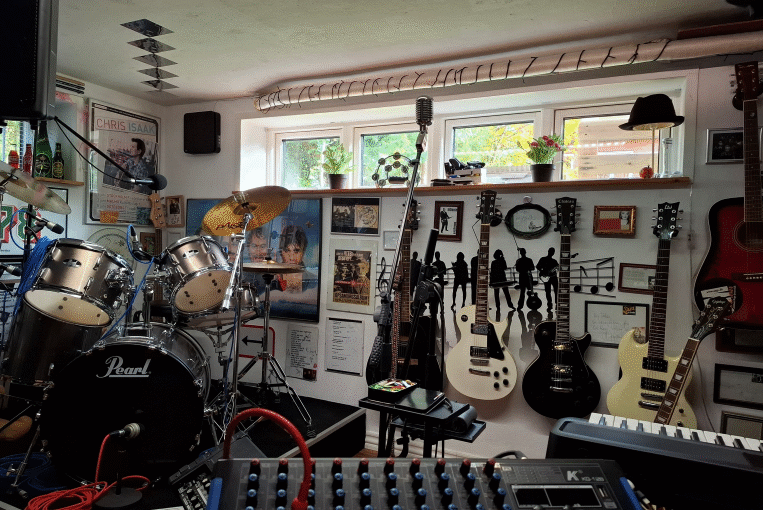
Basement
Create a better indoor climate in your basement
Many Danes experience problems with dampness in their basements. The soil around the basement is wet and damp, and many basements are poorly insulated. At the same time, the windows in basements are often small, which can make it difficult to ventilate properly.
In many homes, the laundry room is located in the basement, which also increases moisture levels. Laundry contains up to 2-3 litres of water when freshly washed and evaporates into the air when hanging on a drying rack.
Too much moisture in your basement can cause problems with mould, mildew and bad odours. Mould can cause headaches, eye, nose and upper respiratory tract irritation, coughing, fatigue and skin rashes, and people with asthma and allergies are particularly sensitive to the furry fungus. If you have an old house, the moisture can also have major consequences for the structure of your home. Among other things, it can cause serious damage to woodwork.
The basement is also the level in your home that is most exposed to radon radiation. We guide you on what you can do to reduce moisture and radon levels.
Check the radon level in your basement
Radon is a radioactive gas that can damage our cells and eventually cause lung cancer. The gas is found everywhere underground and enters our homes through cracks and crevices. Because the gas seeps up from underground, the basement is the most vulnerable level in the home.
Since 1998, it has been a requirement that new buildings must be radon-proofed. In 2010, it was clarified that radon levels in new buildings must not exceed 100 Bq/m3 indoors. Many older homes are therefore not radon-proofed and have several cracks and leaks, so the level can be high in the basement.
You can measure the radon level in your basement with a dosimeter that you hang up for 2-3 months. Then you send it for analysis. If the radon level is below 100 Bq/m3, you don't need to do anything, but if it's higher, you need to bring it down by ventilating, getting a mechanical ventilation system or renovating your home.
How to check your basement for moisture and mould:
- Use your senses: Does it smell mouldy? And are the outer walls moist when you touch them?
- Check your walls: Is there plaster and paint peeling? Dark stains on the walls or behind the wallpaper? 1TP7Does paint peel like bubbles?
- Check your furniture: Are there dark stains and stains? Does the woodwork feel damp? Is there any moisture damage on your shelving?
- Check your floors: Are the drains blocked? Are there bubbles in the floor paint? 1TP7Do dark stains appear on the floor, or on the back of the floor?
- Check the ceiling: Are there dark patches?
If you can answer yes to one or more of these questions, then the humidity is probably too high and the dark patches are most likely mould.
Tips and tricks
How to prevent moisture in the basement
First of all, you can buy a hygrometer that measures the humidity in your basement. If the humidity is above 70 %, your basement will most likely be affected by mould. The humidity should be below 40-45 % in winter and below 60-65 % in summer.
A certain amount of moisture in the basement is inevitable, but you can significantly reduce the level by taking a few simple steps:
- Do not dry laundry in the basement.
- Ensure good ventilation - the air should be changed frequently, at least 3 times a day for 5-10 minutes. Install a mechanical ventilation system if necessary.
- Switch on the heating - heating helps keep the basement dry.
- Avoid humidity in summer - the air is more humid in summer, so air out late at night or early in the morning to avoid letting the hot, humid air in.
- Place furniture a few centimetres from the outer walls to ensure better air circulation.
- Make sure rainwater is directed away from your home - the pipes and lines that carry rainwater away from the house must not be blocked. Also, the terrain around your home should slope away from the building so that puddles don't accumulate around your home.
- Set up moisture removers or hang moisture bags - they collect moisture from the surrounding air and are cheap.


Invest
Consider investing in a ventilation solution
DUKA Ventilation has participated in several projects investigating whether ventilation can reduce the occurrence of radon. The results have been extremely positive, and the incidence of radon has been reduced by up to 90 %. Added to this are the additional benefits of ventilation in terms of a good indoor climate with fresh air around the clock, minimised heat loss and the removal of moisture from the home - all of which contribute to a healthy indoor climate.
We recommend DUKA One, which is a ventilation solution that ventilates the room 24 hours a day. For 70 seconds, the system sucks out stale and moist air, storing heat in the unit's ceramic core. After 70 seconds, the system's motor reverses and blows in fresh air that is heated by the ceramic core. This constantly changes the air, ventilating away particles and moisture and saving you money on your heating bills as the heat in your home is recycled. We install DUKA One directly in the outer wall and can be installed wherever there is a need for ventilation.